
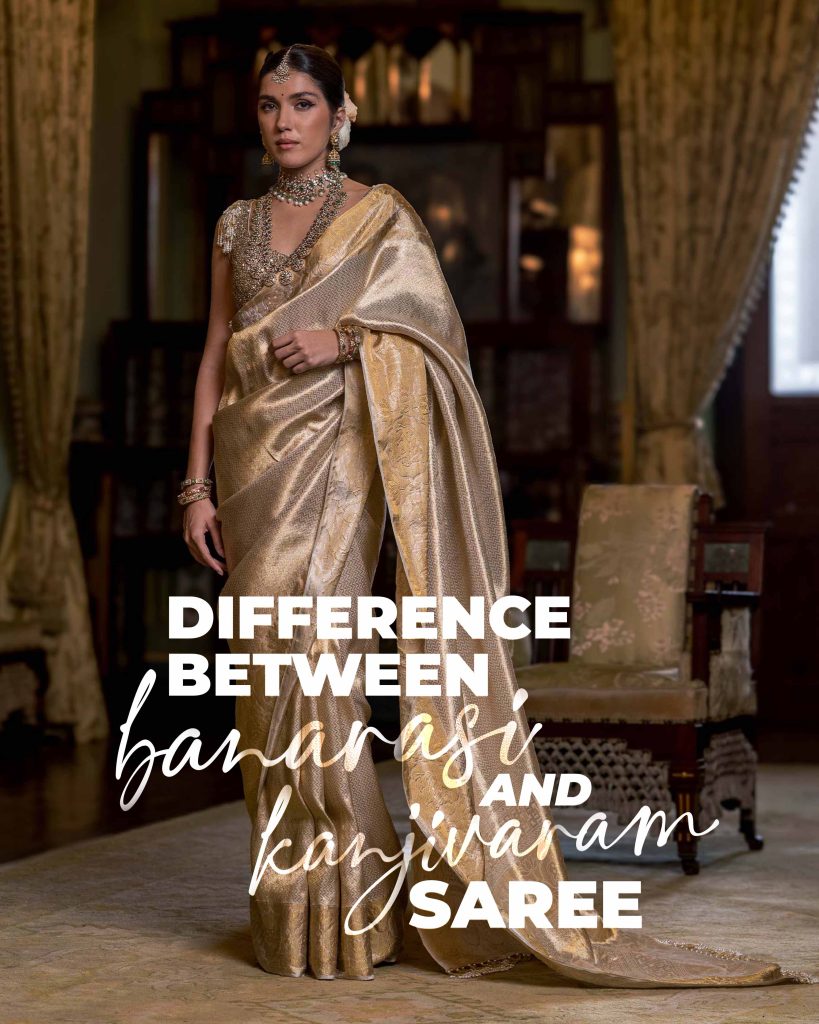
Silk sarees are the crowning glory of India’s textile heritage, and Banarasi and Kanjivaram silk sarees are the two jewels that shine the brightest. These handloom sarees are a testament to the impeccable craftsmanship of Indian weavers, exuding elegance and timeless charm at every glance.
Whether you want to get ready for a wedding, a cultural event, or a festive celebration, you can never go wrong with a meticulously crafted silk saree. While both Kanjivaram and Banarasi sarees are hand-woven silk sarees, several differences set them apart. Come along as we talk about some of their key characteristics.
What is a Banarasi Saree?
Banarasi sarees are a regional iteration of silk sarees that come from the city of Banaras in Uttar Pradesh. These meticulous handwoven pieces showcase the rich culture and impeccable craftsmanship of Indian weavers. These designer sarees are best known for their fine silk, intricate embroidery and use of real gold and silver thread work, adding to their timeless charm.
Origin and History of Banarasi Saree
The origin of Banarasi silk sarees is suggested to have bloomed during the Mughal era, back in the 14th-17th centuries. It is believed that famine-struck Gujarati weavers moved to Banaras for refuge and brought their skilled weaving techniques along with them. The craftsmanship of the weavers was combined with Persian artistic designs under the Mughal patronage, contributing to the emergence of Banarasi silk sarees.
Fabric, Weaving and Texture of Banarasi Sarees
Fabric: Originally, Banarasi sarees were woven from the finest quality silks, catering to the affluent part of society. But today, Banarasi sarees are available in more affordable and versatile fabrics like organza and georgette, mimicking the original look without the hefty price tag. However, true Banarasi saree admirers don’t shy away from shelling out big bucks for a regal piece of craftsmanship that is rooted in culture and tradition.
Weaving: There are different types of weaving techniques, like brocade, kadhwa, jangla, tanchoi and rangkat, involved in making Banarasi silk sarees. Each technique is used to achieve distinctive results. For instance, brocade is one of the most popular techniques used to create raised patterns and intricate designs while incorporating gold and silver threads through the weave. Kadhwa, on the other hand, is an elaborate technique where each motif is woven separately and requires two weavers to get it right.
Texture: Banarasi silk sarees are loved for their luxurious and lustrous texture. Typically, premium-quality silk is used to weave these sarees, adding to their soft and cascading drape. These party-wear sarees usually feature a slightly raised texture and often feature small floats on the reverse side. However, different fabrics can change the texture of the saree slightly. For instance, katan silk has a smoother and softer texture, while fabrics like georgette and organza have a delicate, sheer and crisp feel.
Signature Designs and Motifs in Banarasi: Banarasi sarees feature detailed motifs inspired by different aspects of nature, Indian mythology and Mughal art. The most cherished designs include floral motifs, such as lotuses, roses, and marigolds, in the form of vines or creepers. Paisleys and jhallar motifs commonly feature on the pallu of the saree, adding to its beauty. Other timeless designs include small buttis, or motifs, scattered over the saree; the jangla—an all-over pattern mimicking a sprawling jungle; and fauna motifs, such as parrots, peacocks and elephants.
What Is a Kanjivaram Saree?
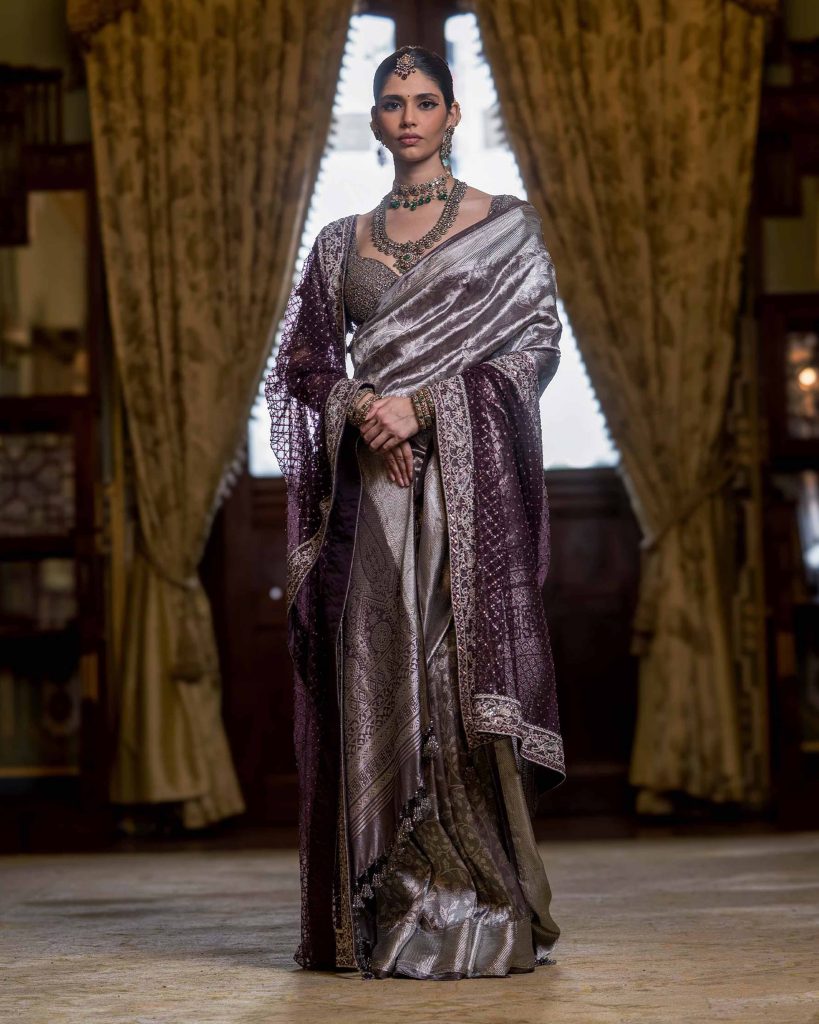
Originating in the town of Kanchipuram in Tamil Nadu, Kanjivaram sarees are the traditional silk sarees known for their rich texture, intricate designs, and vibrant colours. These festive wear sarees are made from pure mulberry silk, featuring detailed gold/silver zari work with motifs featuring temple architecture, flora, fauna, paisleys, etc.
Origin and Heritage of the Kanjivaram Saree
The origin of Kanjivaram sarees is linked to the city of temples, Kanchipuram in Tamil Nadu, during the reigns of the Pallava dynasty, the Cholas, and the Vijaynagar in the 7th century CE. It is believed that
Fabric, Weaving Technique and Texture of Kanjivaram
Fabric: An authentic Kanjivaram saree is always woven from pure mulberry silk sourced locally. The silk thread is extracted from mulberry silkworms following a labour-intensive process, making these sarees even more special. For genuine Kanjivaram sarees, the glimmering zari-work is made by twisting fine silver wire around a silk thread and electroplating it with gold. This golden thread is then incorporated into the weave, creating intricate motifs and detailed borders.
Weaving Technique: Kanjivaram silk sarees follow a super unique weaving technique called the ‘korvai’ method. This method involves weaving different components of the saree separately and then attaching them using the traditional interlocking technique. This process requires two to three weavers to work together, as each bridal saree uses multiple coloured threads in its weave.
Texture: The Kanjivaram sarees have a smooth, thick and luxurious texture, featuring a firm yet smooth drape. Pure Kanjivaram sarees are fairly heavy, as they are made from three-ply silk yarn and gold zari. The sarees have a natural sheen that is not an overly glossy shine.
Designs, Motifs and Borders in Kanjivaram
Kanjivaram sarees are known for their traditional and nature-inspired motifs and borders.
Traditional Motifs: Common traditional motifs include peacocks, paisleys, mythical creatures, temple motifs, floral creepers, animal and bird motifs and geometric patterns.
Border Designs: Popular border designs include temple border, getti border, retta pettu, korvai border, and kasa kasa kattam.
Key Difference Between Banarasi and Kanjivaram Saree
Factor | Banarasi Saree | Kanjivaram Saree |
| Origin | Varanasi, Uttar Pradesh (North India) | Kanchipuram, Tamil Nadu (South India) |
| Silk & Texture | It is comparatively lightweight, uses finer and softer silk, and has a more fluid drape. | Made from pure mulberry silk, is heavier, structured and very durable. |
| Weaving Style | Brocade weaving with rich zari across the body and border. | Korvai/pinti join of body and border using heavy silk and zari. |
| Motifs | Mughal and Persian-inspired designs, including floral, foliage, jaal, and paisley. | Temple motifs, checks, stripes, peacocks, elephants, mythological scenes. |
| Colour Story | Often featuring jewel tones, reds, greens, and golds are suitable for many North Indian occasions. | Strong contrast combinations like maroon, royal blue, emerald, purple, gold, and silver for bridal looks. |
| Price & Value | A wide range from mid to premium, lighter options are also available. | Generally, more expensive due to pure mulberry silk and high zari content. |
| Best For | Versatile: weddings, receptions, festive parties, formal events. | Traditional South Indian weddings, temple rituals, milestone ceremonies. |
How to Choose Between Banarasi and Kanjivaram Saree?
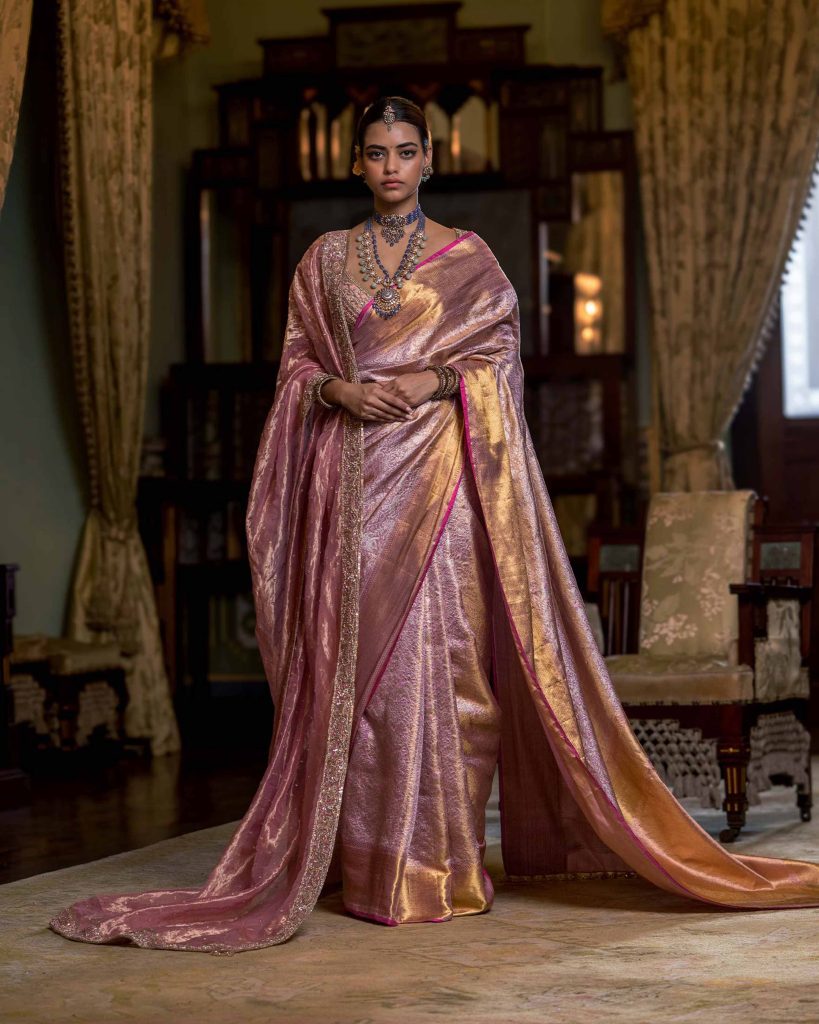
Both Banarasi and Kanjivaram silk sarees are timeless, traditional types of sarees to have in your wardrobe. However, the one you pick truly depends on the occasion, style and personal choice. If you want a lighter and more fluid feel with Mughal-inspired motifs and designs for parties and evening events, then a Banarasi saree would be a better option. Choose a Kanjivaram silk saree if you prefer vibrant colours, a stiffer drape and a heavy feel with nature- and traditional-inspired motifs.
FAQ’s
Which is more expensive – Banarasi or Kanjivaram?
Kanjivaram sarees are more expensive compared to Banarasi silk sarees, as they use premium-quality mulberry silk and real gold/silver zari.
Can I wear Banarasi or Kanjivaram for non-bridal occasions?
Yes, Banarasi and Kanjivaram silk sarees can be worn for non-bridal occasions like festivals, parties, cultural events, etc., as well. Just make sure to pick a lighter and less elaborate saree for these occasions to look appropriately dressed.
Which saree is better for beginners?
Banarasi sarees are better for beginners, as they are lighter and easier to drape compared to Kanjivaram sarees.