
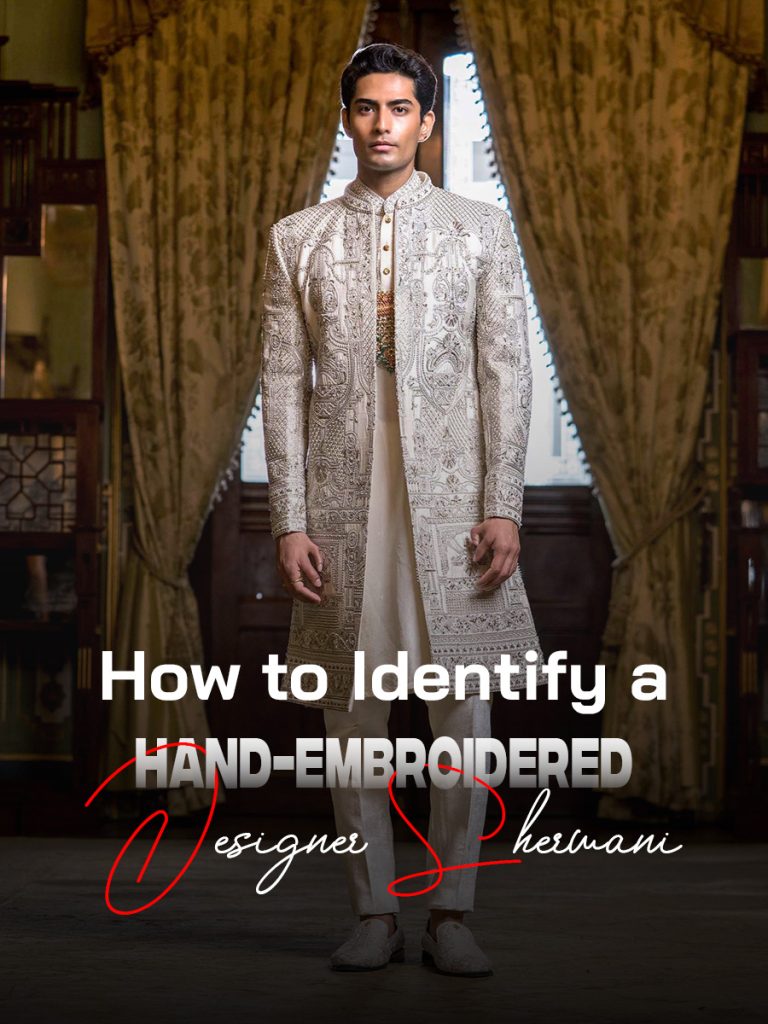
An authentic hand-embroidered designer sherwani can be identified simply by examining four key details: the back, the weight, the variation in embroidery, and the production time. Genuine handwork usually extends beyond the visible front, with embroidery details continuing across the back and sleeves.
The traditional menswear may feel heavier because of its dense threadwork, beads, zari, or other embellishments. Unlike machine embroidery, hand embroidery often has subtle variations in stitch placement, tension, and detailing. It also takes considerably longer to produce, sometimes requiring several weeks or months, depending on the intricacy of the design.
Understanding these details can help you distinguish genuine craftsmanship from machine-made copies. Come along as we explore the key characteristics of authentic hand embroidery, what to look for in the finishing and construction, and how to evaluate a designer sherwani before you say yes to one.
Hand Embroidery vs Machine Embroidery on a Sherwani: What Actually Differs
Hand embroidery and machine embroidery are two entirely different ways to decorate a sherwani. However, both have their own quirks, making one stand out from the other. As the name suggests, hand embroidery is stitched manually by artisans, while machine embroidery is done using automated embroidery machines.
Look and Texture
While both styles are ideal for achieving beautiful patterns and motifs, the product produced manually has minor variations in stitches and spacing. Machine embroidery, on the other hand, showcases more uniform stitches, identical motifs, and continuous threads on the reverse side.
Materials and Drape
Hand embroidery uses silk or metallic threads, sequins, and beads combined with traditional manual techniques, creating a heavy yet soft drape. Machine embroidery often uses dense, tight stitches using synthetic threads and backing, creating a stiffer feel.
Cost and Timeline
Hand embroidery is a laborious process that takes far more hours and requires skilled labour, making it cost way more. Machine embroidery is quicker and affordable, especially when looking for an outfit for celebratory occasions or simpler motifs.
Criteria | Hand Embroidery | Machine Embroidery |
Reverse Side | Usually shows visible knots, thread ends and irregular stitches. | Generally, has bobbin thread and stabiliser; the back looks more uniform and structured. |
Raised Texture | Can create rich, varied and highly raised textures using different stitches and thread layering. | Usually has a flatter, more uniform texture, although special techniques can create raised effects. |
Weight | Generally lightweight, depending on the thread and density of embroidery. | Can be heavier due to dense stitching, backing and stabiliser. |
Motif Variation | Offers unlimited creativity, intricate detailing and freedom to create unique motifs. | Motifs are usually pre-digitised, allowing consistent and repeatable designs. |
Edge Finish | Edges may have slight irregularities but can be finished neatly with skilled stitching. | Edges are generally clean, precise and uniform, with consistent outlines. |
Time Taken | Time-consuming, as each stitch is made individually by hand. | Faster, as designs are stitched automatically by a machine. |
How To tell If a Sherwani is Hand-Embroidered: Step-By-Step Checks
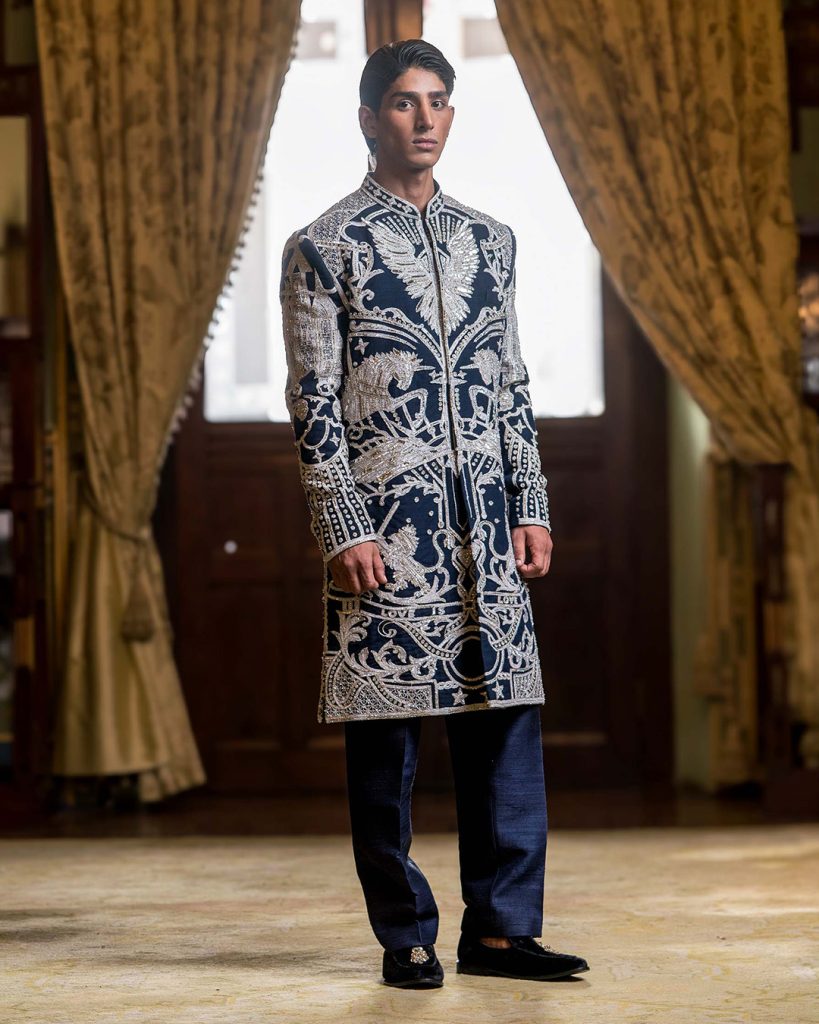
The only way to identify hand-embroidered engagement sherwanis, like ones featuring zardozi, chikankari, or aari work, is through close inspection. Check for stitch uniformity, construction, and motif symmetry to differentiate between a hand-embroidered and machine-embroidered sherwani.
Check the Reverse and the Inner Edges: One of the key ways to check if a sherwani is hand-embroidered is to just turn it inside out and check if it has tiny knots, tied-off threads, and small jump stitches. All these elements prove that the sherwani is hand-embroidered.
Feel the Relief and the Weight: Gently run your fingers over the motifs to get a feel of them. Handwork, zardozi and aari work create a three-dimensional, raised texture that often uses metallic wires, beads and dense silk threads that feel hefty. On the other hand, machine embroidery feels lighter and flatter.
Look for Natural Variation Across Motifs: Human hands cannot replicate a pattern with robotic precision. Therefore, no two motifs will ever look identical when made with hand embroidery. Look at repeating patterns like leaves, flowers, or paisley to check if the designs are 100% identical or if they vary.
Ask About Production Time and Artisans: When buying from boutiques or designer brands, the timeline gives it away mostly. If a sherwani is taking 3-8 weeks to get delivered, then it is most likely a hand-embroidered sherwani. Machine-embroidered sherwanis can be made in a few hours.
How To Identify Real Zardozi, Dabka, Aari and Resham Work?
The biggest giveaway for handwork embroidery is the irregularity and slight asymmetry. Genuine handwork will always show slight irregularities rather than uniform machine perfection.
Zardozi and Dabka: Zardozi is an intricate raised metallic embroidery that uses zari, beads, sequins, and coils stitched onto the fabric. Dabka uses tightly coiled metallic wire cut into small pieces and stitched onto the fabric to create clean patterns and motifs. Both of them look and feel dimensional, making it fairly easy to identify.
Aari Work: Aari work is an extensive and intricate embroidery style that uses a hooked needle to create continuous chain stitches, forming stunning patterns and motifs. Authentic aari embroidery has a smooth texture and showcases unbroken chain loops.
Resham and Zari Thread Work: To ensure authentic resham and zari work, check the reverse side of the fabric. Slight stitch variations, subtle size differences, and softer thread paths mean hand embroidery. Machine embroidery lies flat and features super tight stitches.
Check The Fabric, Lining and Construction Too
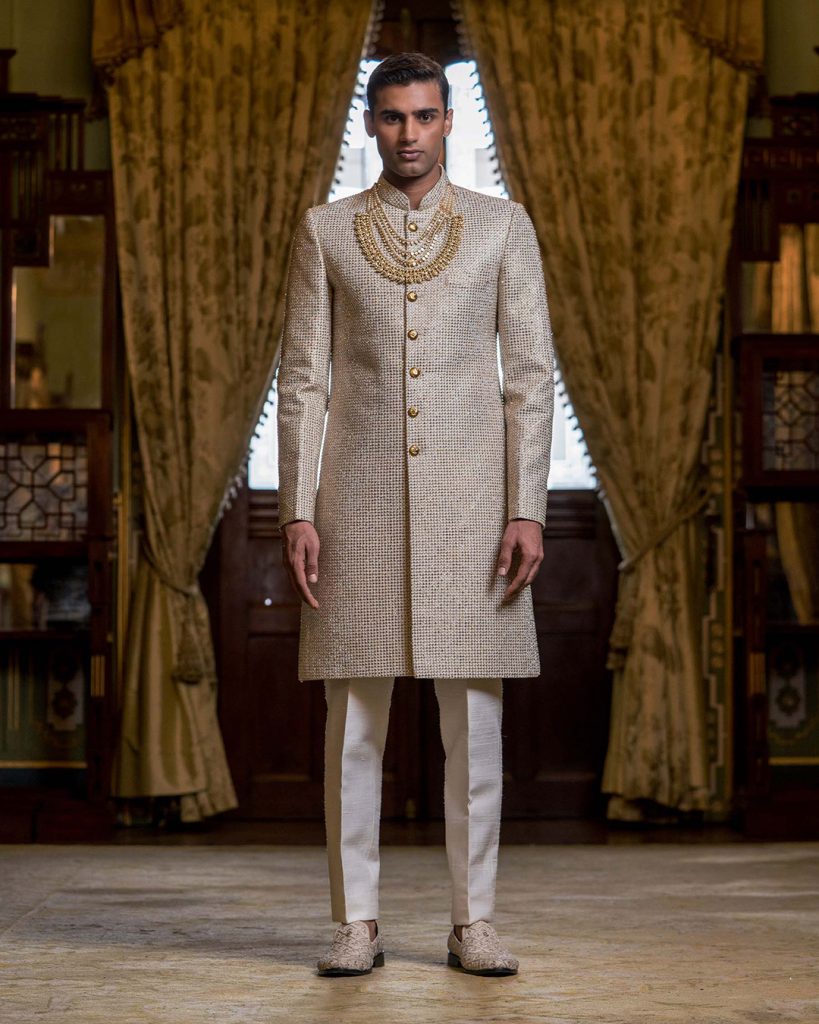
A handmade wedding sherwani is not that difficult to differentiate from a machine-made one through the fabric, lining and the construction itself.
Outer Fabric
A handmade sherwani could be tailored from both handwoven fabrics and power loom fabrics, and both are amazing base choices regardless. The one you choose comes down to personal preferences. Handloom fabrics offer a more rustic charm with small irregularities, fabric knots, and softer surfaces. Power loom fabrics appear uniform and have a slick and smooth surface.
Lining
High-end designer sherwanis use breathable fabrics for their linings, such as mulmul, pure cotton, or Bamberg silk, ensuring maximum comfort and a seamless drape. Another thing to check is how the lining is attached to the main garment. Handcrafted sherwanis almost always feature linings attached with fine, hand-slip stitches compared to a single thick machine topstitch used in mass-produced sherwanis.
Construction
Examine the buttons and buttonholes closely to ensure they are made neatly with tiny organic variations. Look inside to check if there is extra seam fabric for future alterations, finished with bias binding for a cleaner look. Another common construction characteristic of bespoke sherwanis is pick stitching along the edges of the band collar.
How To Confirm You Are Buying a Genuine Designer Sherwani?
There are some crucial points to consider when buying a genuine designer sherwani.
Verify the seller and pricing: The best way to be sure about the authenticity of the sherwani is to buy directly from the designer’s official website, flagship store, or authorised retail partners. At all costs, avoid trusting unverified resellers and social media pages.
Inspect labels, embroidery, and hardware: Check for genuine labels with consistent branding, clean typography, and care tags. Contrary to popular belief, hand-embroidered pieces have small inconsistencies but an unmatched finish. Look for uniform threadwork or zardozi that is not laid flat.
Check fabric and inner construction: Check if the base fabric used to tailor the reception sherwani is a luxurious one like silk, velvet, cotton-silk blend, or jamawar. Turn the sherwani inside out and look for tight stitching, reinforced high-stress areas such as shoulders and underarms, and clean seams.
Confirm hand vs. machine work: Inspect the sherwani closely to ensure that the details are handmade and not achieved through machines. Check for clean and even detailing without loose threads or messy backing to ensure that your sherwani is handcrafted.
FAQ’s
How do I tell if sherwani embroidery is hand-done or machine-made?
Flip the sherwani inside out and inspect the stitch consistency, texture, and motif symmetry. With handwork embroidery, you will notice organic variations, while machine-made sherwanis feature uniform embroidery.
How can I tell if a sherwani is good quality?
A good quality sherwani uses heavy fabrics, features inner lining and handwork embroidery, has uniform stitching, and has a seamless overall structure and fit.
What is the difference between zardozi and zari work?
Zari work uses metallic gold and silver thread to weave intricate, flat motifs on the fabric. Zardozi, on the other hand, is a 3D hand embroidery technique that uses metallic threads, coiled wires, sequins, beads, and stones on the fabric.
How can I tell Aari work from machine embroidery?
To tell hand aari work apart from the machine one, inspect stitch uniformity and subtle variations in repeated motifs.
Will my sherwani look like the picture?
A sherwani can match the picture in terms of silhouette, colour, and fabric, though exact details and how it sits on your body may vary.